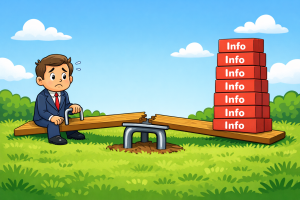
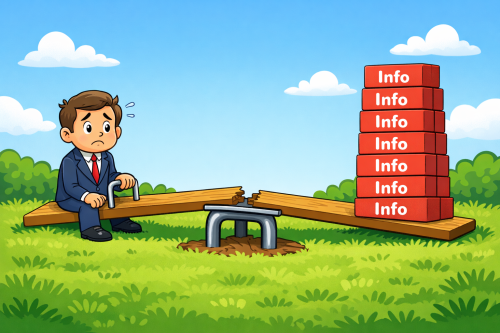
The more you explain your offering, the harder it becomes for someone to decide.
I mean that literally. Not as a persuasion principle or a communication preference. I mean that explanation, deployed at the moment a decision needs to happen, increases the cognitive effort required to make that decision. And once you start explaining, the opportunity to create clarity is already gone.
This shows up everywhere. A consultant on a sales call senses confusion and adds another layer of detail about methodology. A coach notices hesitation and launches into a case study about a previous client. A founder builds a landing page that attempts to preemptively answer every possible objection before the visitor can click. In each case, the decision becomes harder, not easier. The conversation stretches longer without resolution. The prospect says “that makes sense” but does not move forward. The page attracts traffic but converts poorly.
What these professionals are doing, without realizing it, is raising cognitive load at the precise moment the brain needs constraint.
Cognitive load is how much a person has to hold in their head at once. It is the number of moving parts they are tracking, the variables they are comparing, the implications they are weighing, the questions they are forming. More information does not reduce cognitive load. It compounds it. And decision-making, unlike learning, does not benefit from accumulation. It benefits from simplification.
There is a fundamental difference between the learning moment and the decision moment, and most business owners collapse them without awareness. In a learning moment, additional context can help. You are building understanding, exploring options, gathering perspective. The goal is comprehension. But in a decision moment, extra context creates friction. The goal is not to understand more. The goal is to choose. When you introduce more variables at the decision point, you are not clarifying. You are asking the prospect’s brain to do more work.
How It Works
Here is the mechanism. Every detail you add in explanation introduces a variable the prospect must now process. Each variable creates a comparison. Each comparison generates a possible objection. Each objection opens a new path the brain has to evaluate. The prospect shifts from “choose” to “analyze.” Analysis feels responsible. It feels careful. But it delays commitment. And in a sales context, delay is functionally identical to decline.
The trap is that explanation creates the illusion of progress. Talking feels like forward motion. When a prospect says “that makes sense,” it registers as agreement. But “that makes sense” is acknowledgment, not commitment. It means they followed your reasoning. It does not mean they have decided. Longer conversations can feel productive, but they are often a signal that clarity is declining, not improving. You are adding information. They are accumulating questions.
This is where irreversibility becomes critical. Once you are explaining, you are reacting to a decision that did not happen. You are attempting to repair clarity that was already missing. But you cannot fix clarity midstream by adding more words. You can only add words. And those words increase cognitive load further. The pattern becomes a spiral: confusion leads to explanation, explanation adds variables, variables create more confusion, more confusion prompts more explanation. You cannot reverse out of this. You are already past the point where constraint would have worked.
This is the hinge. Explanation does not rescue a stalled decision. It formalizes the stall.
Smart professionals are especially vulnerable to this pattern, and the vulnerability comes from two sources: survivorship bias and pattern blindness. Expertise increases internal complexity. When you know a subject deeply, you see distinctions that matter to you but may not matter to the decision at hand. Familiarity makes omissions invisible. You do not realize what you have left out because the missing pieces are obvious to you. Past success teaches the wrong lesson. You remember the clients who said yes after a long conversation, and you conclude that explaining worked. You do not count the prospects who disappeared after the same conversation, because you interpret that outcome as normal sales friction, not as a symptom of your process.
Survivorship bias tells you, “I succeeded, therefore my explanation strategy is correct.” Pattern blindness tells you, “I do not notice how often this stalls decisions because I have normalized the pattern.” Together, they create a professional blind spot that is almost impossible to self-diagnose.
This is also why “better messaging” often fails to solve the problem. Messaging polish is downstream. If the decision structure is wrong, better words just accelerate the wrong structure. You can script the explanation more elegantly. You can tighten the language. You can A/B test subject lines. But if you are still asking the prospect to hold too many variables at the decision point, the cognitive load remains. Scripts do not remove cognitive load. They can formalize it.
What clarity actually requires is constraint before communication. Fewer moving parts at the decision point. Deciding, in advance, what will not be explained. Separating education content, where detail belongs, from decision content, where constraint belongs. This is not about withholding information. It is about recognizing that the decision moment has a different job than the learning moment, and designing your communication accordingly.
Explanation increases cognitive load. Cognitive load reduces decisions. Irreversibility means you cannot repair it mid-conversation. If you are explaining more, the decision got harder.